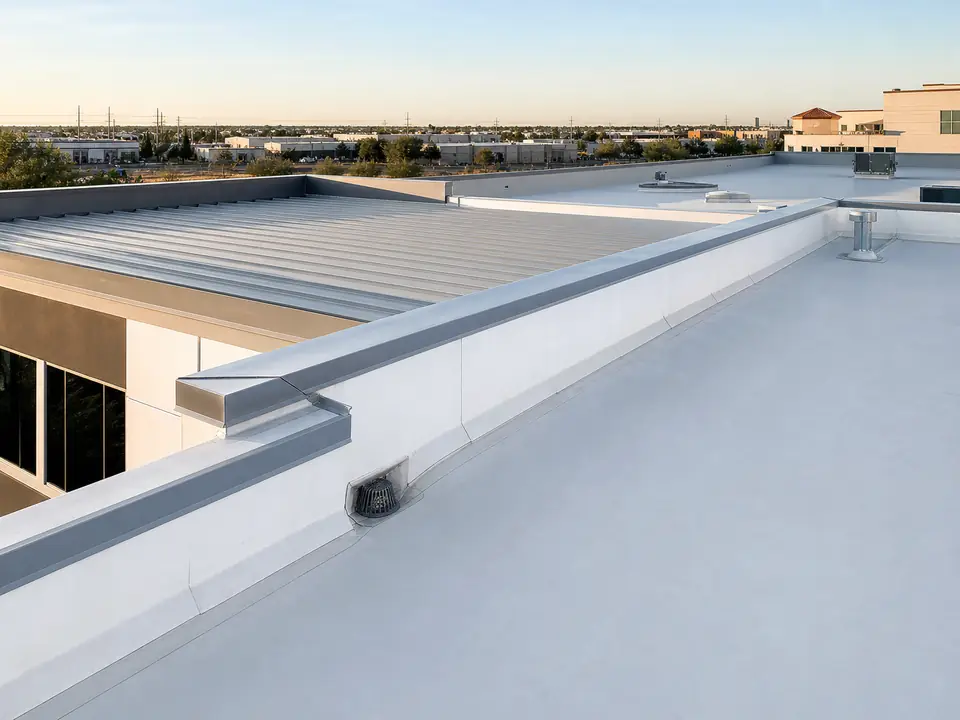
LaredoRoofer provides repair, replacement and restoration services for commercial roofing systems in Laredo.
Identify the Existing Roof First
Commercial buildings may use:
- TPO
- modified bitumen
- metal roofing
- coated systems
- other low-slope assemblies
The roof needs to be identified before materials are ordered or repairs begin.
A repair product that works with one membrane may not be suitable for another.
How Commercial Roof Leaks Are Investigated
Begin with the interior evidence.
Record where water appears and whether the leak only happens during certain rainfall or wind conditions.
On the roof, compare that area with:
- membrane seams
- rooftop equipment
- curbs
- drains
- scuppers
- pipes
- roof hatches
- parapets
- perimeter flashing
- previous repairs
Water can travel within parts of the roof or building structure, so the exterior defect may not be directly above the interior drip.
Membrane Seams
Single-ply roof membranes rely on properly constructed seams to connect large sheets into one weathering surface.
During a TPO inspection, seams deserve attention along with the field membrane.
Repairs need compatible materials and proper surface preparation.
The surrounding membrane must also remain in suitable condition for the new repair to tie into it.
Rooftop Equipment and Curbs
Commercial roofs frequently support HVAC equipment and other building systems.
The curb connecting that equipment to the roof interrupts the membrane and requires dedicated flashing.
Service personnel also need to reach rooftop equipment over the life of the building.
That means roof traffic can affect certain areas more than the rest of the membrane.
Roof Penetrations
Pipes, conduits, vents and other penetrations interrupt the continuous roof surface.
Each needs a detail that accommodates the roofing system while keeping water out.
When leaks appear near a penetration, the surrounding flashing should be inspected instead of assuming the broad membrane has failed.
Drainage
Low-slope roofs still need to move water away.
Drains and scuppers should remain unobstructed.
Areas where water routinely collects deserve evaluation because the cause can involve blocked drainage, roof geometry, structural movement or other conditions.
Applying a coating across the roof does not correct the cause of poor drainage.
Commercial Roof Repair
A localized defect can often be repaired when the surrounding roof remains serviceable.
Typical repair areas include:
- membrane damage
- seams
- flashing
- curbs
- penetrations
- drains
- perimeter details
- localized metal-roof failures
The existing system determines the correct repair method.
Commercial Roof Replacement
Replacement becomes more practical when deterioration or underlying damage affects enough of the roof that isolated repairs are no longer controlling the problem.
Planning may include:
- existing deck
- insulation
- cover board where used
- membrane or panel system
- drainage
- equipment curbs
- penetrations
- perimeter attachment
- access requirements
Replacing a commercial roof should improve the entire assembly rather than simply give the building a new surface.
Roof Restoration
Some commercial roofs remain suitable for restoration.
The process begins with inspection.
Damage and leaks are repaired. The surface is cleaned and prepared. Compatibility with the chosen coating system is confirmed before application.
A roof that has widespread underlying failure should not be presented as a coating candidate simply because coating costs less than replacement.
Commercial Roof Maintenance
Maintenance is especially useful on roofs that receive regular service traffic.
Inspections can review:
- seams
- penetrations
- drains
- scuppers
- rooftop equipment
- flashings
- perimeter areas
- previous repairs
- membrane damage
Photographic records make it easier to determine whether a condition is changing over time.